
A family story that wrote the first chapter of winemaking in Thesprotia
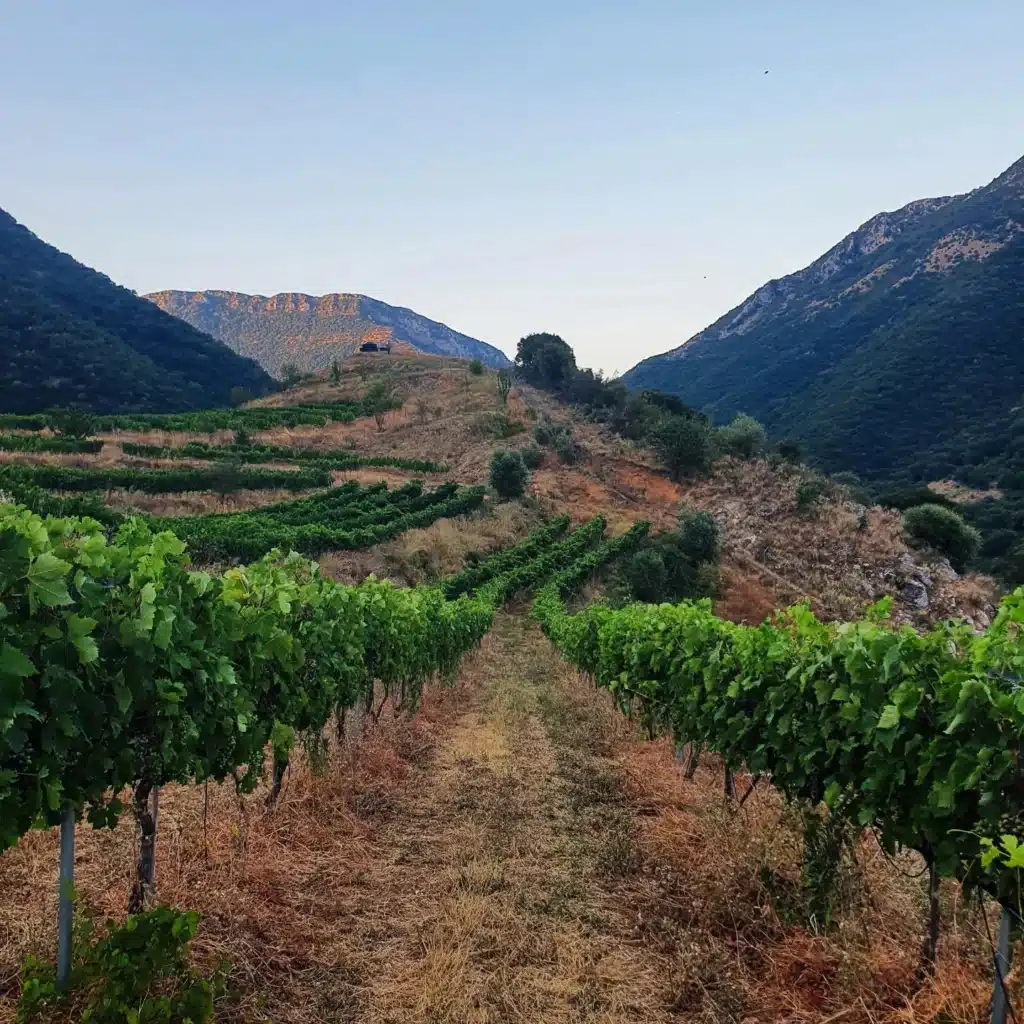
In Dafni near Filiates, in a beautiful corner of Thesprotia among mountains, lush greenery and small streams, at the foot of Mount Farmakovouni, the heart of the first winery ever created in the prefecture has been beating for two decades. Markatselis Family Winery is not just a wine producer. It is a story of family, passion, persistence and a deep bond with the land of Epirus. A story written by two generations which, now that the winery marks 20 years, deserves to be told from the beginning.
From grandfather’s old vineyard to the first winery in Thesprotia
The story begins in 1992, when the dentist Spyros Markatselis decides to fulfil an old dream from his student years: to make his own wine. He replants his grandfather’s old vineyard in Dafni with 40 new vines and starts making wine as an amateur, for friends and acquaintances. Alongside his medical career at Filiates hospital, he spends his afternoons in the vineyard. He does not change course; he simply adds another one.
By 1998 the vineyard has grown and, encouraged by friends, Spyros decides to move into bottling and selling. In 1995 he had made his first wine, and since then the winery has consistently produced low-intervention wines following the traditional method of winemaking.
The big moment comes in 2006, when the Markatselis family obtains the first winery and bottling licence in the prefecture of Thesprotia. It is a historic step not only for the family but for the whole area: Thesprotia officially has its first winemaker.
The second generation: Alexandros comes home
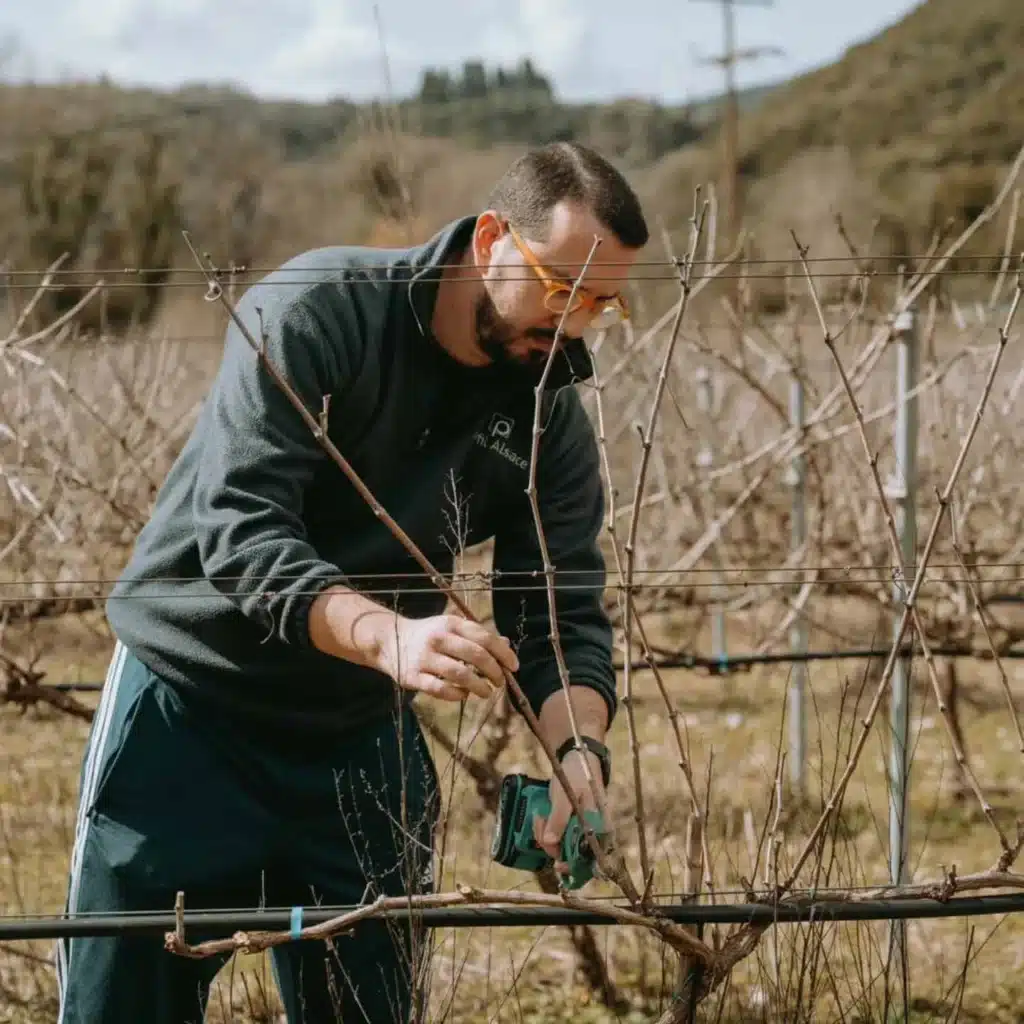
The younger generation takes the stage in 2020. Alexandros Markatselis, Spyros’ son, returns home after a decade abroad. In Florence he studied Oenology and Viticulture at the Faculty of Agriculture, worked at wineries in Tuscany, Bordeaux and Saint-Émilion, and also spent time in Athens. He left young and came back with knowledge, experience and, above all, a clear vision.
His first decision: converting the three vineyard plots, 35 stremmata (about 3.5 hectares) in total, from conventional to organic farming. The aim was to give more value to the raw material, the grape, and to respect the mountain that hosts them, Mount Farmakovouni, as well as the local flora and fauna.
Since 2021 the winery has made low-intervention, natural wines, with no chemicals used at any stage of production or ageing. Fermentations are wild, with native yeasts, letting each grape express itself as only it knows how.
The vineyards: three plots at the foot of Mount Farmakovouni
The winery’s three vineyards, more than 30 stremmata in total, spread across the foothills of Mount Farmakovouni at altitudes from 100 to 300 metres.
- The oldest vineyard, next to the winery, is more than two decades old; its planting was completed in 1998.
- The second vineyard, 20 stremmata, was planted in 2015 at 300 metres, just 500 metres from the winery.
- The third, 6 stremmata, was added a year later on the fertile plain of Foiniki, about three kilometres from the winery.
Farmakovouni is no ordinary mountain. It takes its name from its herbs, traditionally used to make medicines; it is part of the Natura 2000 network and a refuge for wildlife. This place gives Markatselis wines their own terroir, a character found nowhere else.
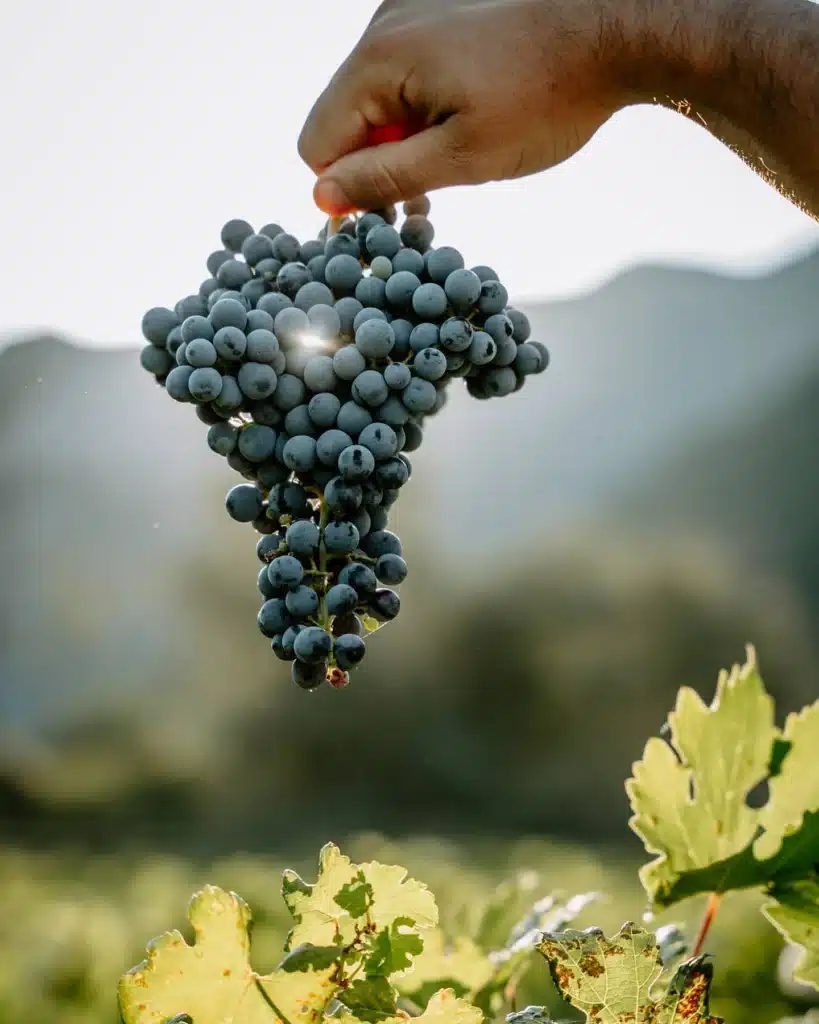
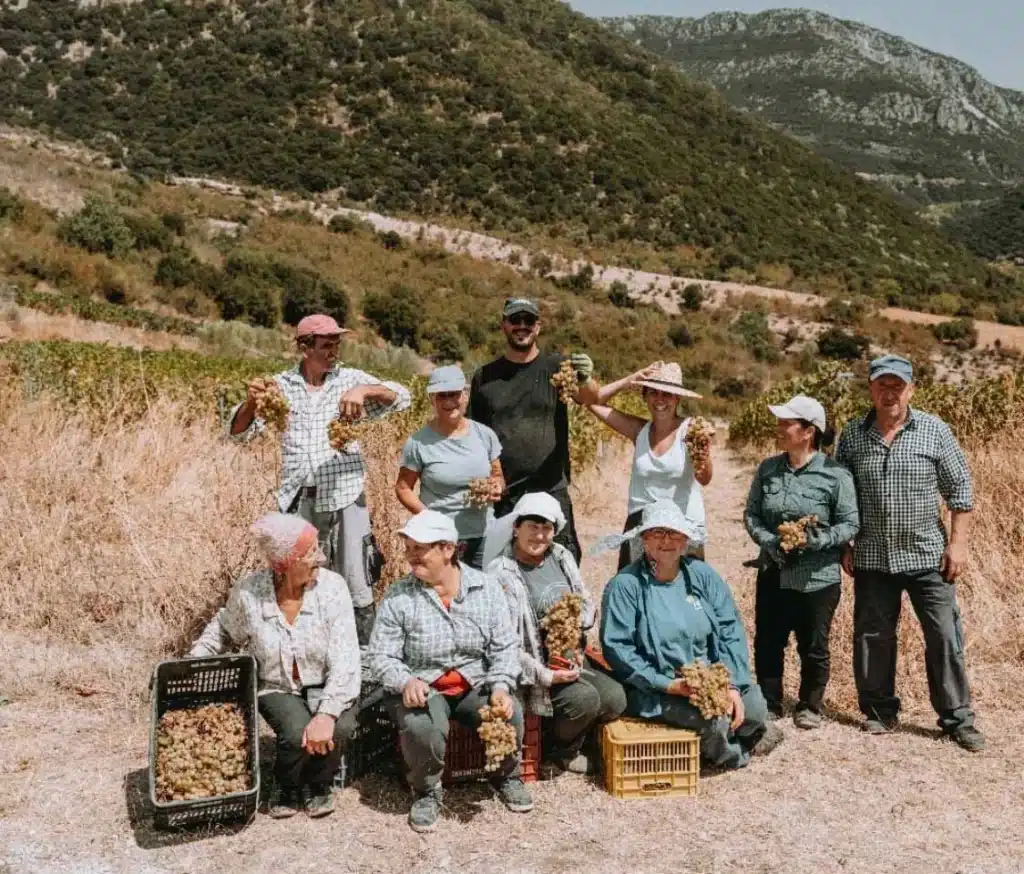
The harvest is done by hand, berry by berry, to keep the quality and consistency of every vintage.
Watch the harvest video on Instagram
The varieties and the wines: from The Sheperd to “Two Generations”
Thirteen varieties, Greek and international, grow in the Markatselis vineyards today:
- White: Chardonnay, Malvasia Aromatica, Debina, Muscat of Alexandria, Assyrtiko
- Red: Agiorgitiko, Merlot, Syrah, Cabernet Sauvignon, Grenache Rouge
- Rosé / gris: Moschofilero, Roditis (Alepou)
The Sheperd series
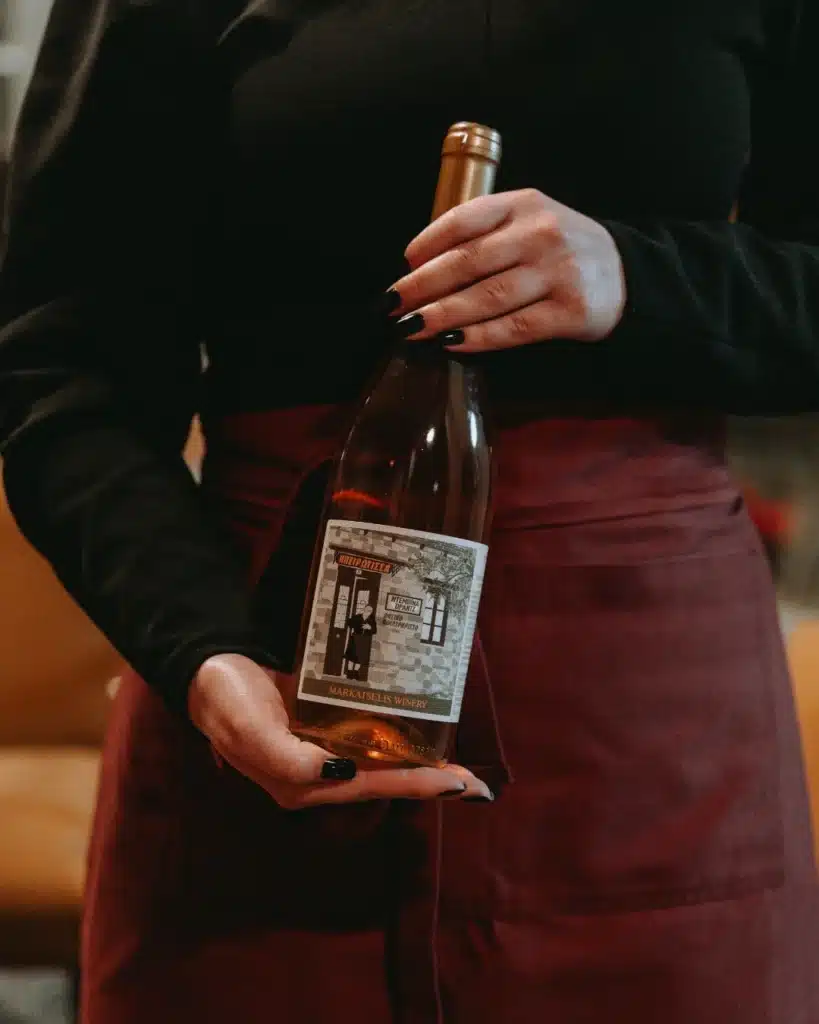
When he came back, Alexandros created The Sheperd series, a tribute to an area with a strong herding tradition and to Farmakovouni, a well-known grazing land. The label shows a wolf-like shepherd: where there are sheep, there are wolves. The winemaker himself has a wolfdog, Simba, a very important member of the family who follows every step of the work closely.
The “Two Generations” trilogy
The winery’s most personal series is “Two Generations” (Dyo Genies), a trilogy that marks the continuity between the family’s two generations of winemakers. It includes:
- An orange wine from Muscat of Alexandria and Assyrtiko
- A premium white from Chardonnay and Malvasia Aromatica
- A red from Merlot and Syrah, aged for 12 months in old oak barrels
The “Two Generations Red 2022” has already found its place on the lists of award-winning restaurants such as Thamon, a recognition that, as Alexandros tells us, calls not for complacency but for daily work.
The winery also makes aromatic drinks such as vermouth and tsipouro.
Wine tourism: when the winery opens its doors
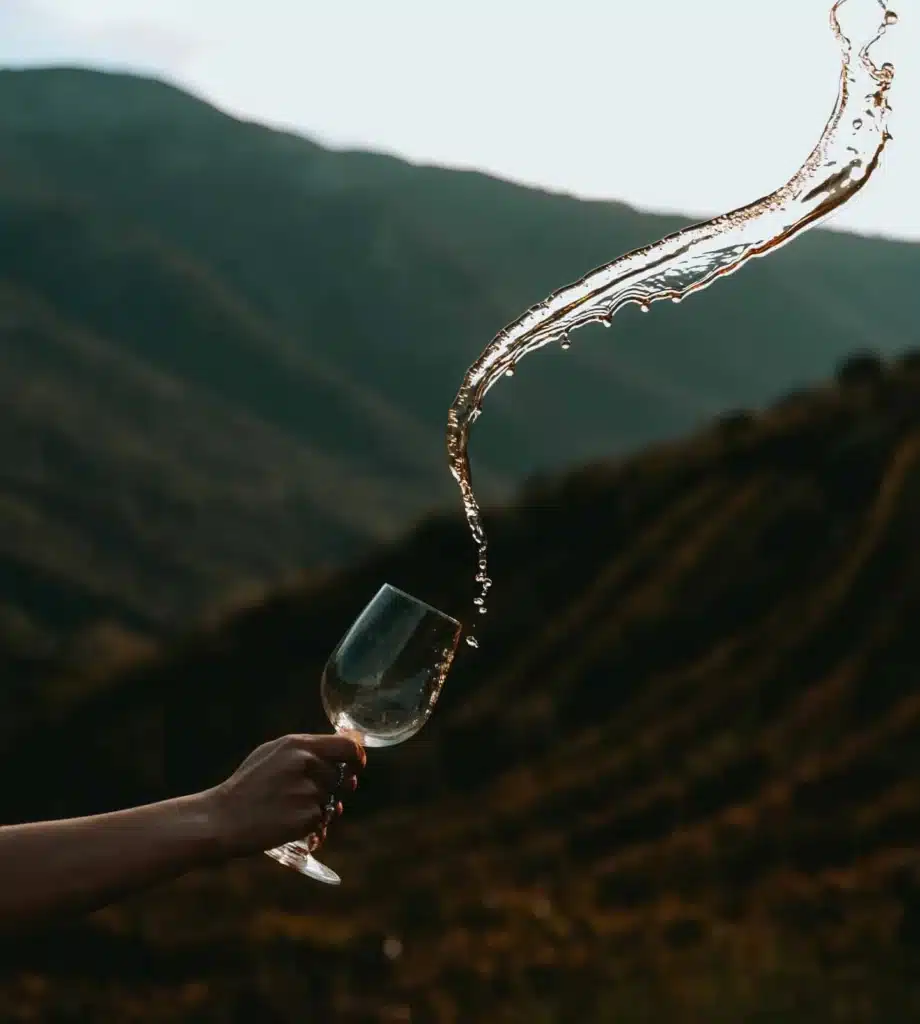
Alexandros’ second big decision was to open the winery to the public. Since summer 2022 Markatselis has welcomed wine tourists, the first winery in Thesprotia to do so systematically. More than 4,000 wine lovers have passed through its courtyard since then.
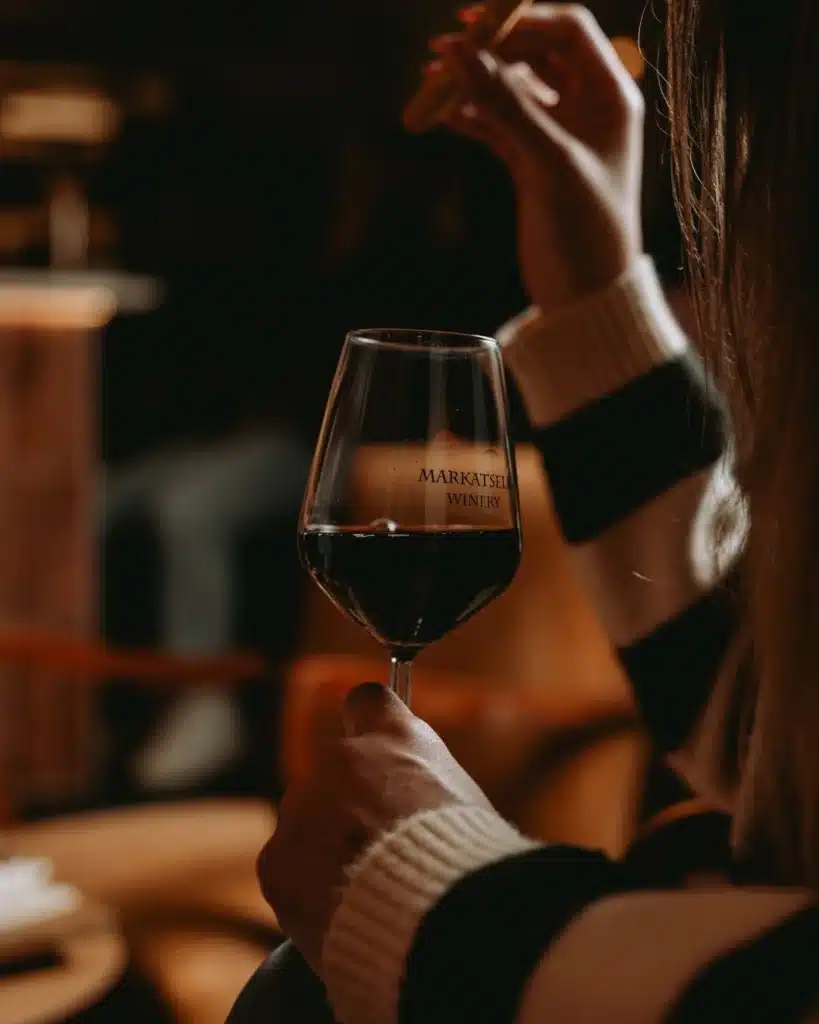
The experiences start with tours of the organic vineyards, continue with a walk through the winery (the cellar, the stainless steel tanks, the bottling area) and end with tastings in a warm, welcoming space. Wine tours run from April to late October, by appointment.
But the winery is not only about wine; it is also about culture. Every summer, once a week, the courtyard came alive with open-air cinema, music nights, shadow theatre and plays: a wine-and-culture summer that began in 2023 and completed its cycle in summer 2025, after three years.
Markatselis Wine Shop: the new venture in Igoumenitsa
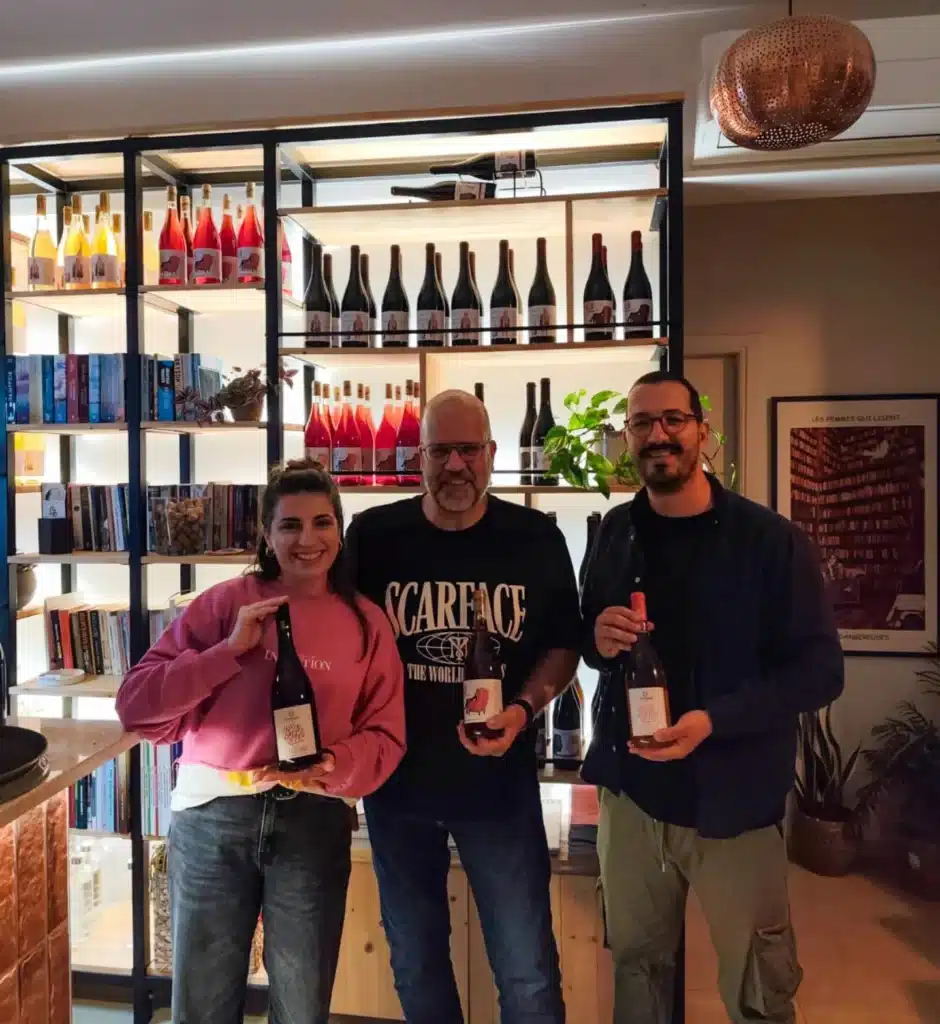
The newest chapter was written a few months ago, with the opening of the Markatselis Wine Shop in the town of Igoumenitsa. Designed by the interior designer Olga Tzafou, it is a small wine shop with jazz music and a warm atmosphere, inspired by the culture of the Italian enoteca and the French bistro.
The idea is simple: the winery travels from the village of Dafni to the town, so that people can get to know its products more directly, and so that a new small cultural hub is created in the prefecture.
Three spaces in one
In the morning it works as a wine shop: daily free tastings of wines and spirits, sales of the winery’s wines and tsipouro, beers from small Greek breweries (mostly from Epirus), Greek vermouths and organic herbs such as mountain tea, chamomile, oregano and mint from Mount Farmakovouni.
In the afternoon it becomes an Italian-style wine bar. Guests can choose from 8 of the winery’s labels, with varieties such as Roditis, Moschofilero, Agiorgitiko, Muscat of Alexandria, Cabernet Sauvignon, Debina, Assyrtiko and Merlot. They come with cold dishes and boards of cured meats (Lefkada salami, Corfu noumboulo, Spanish chorizo, Italian prosciutto) and cheeses (myzithra, kefalograviera, truffle graviera) from local producers in Epirus, as well as bruschetta with Mediterranean products.
The lending library and “Wine Wednesdays”
The space also hosts something special: a lending library with more than 200 books: novels, crime, social fiction, self-help, children’s stories and books about the world of wine. Most are donations from personal collections, and visitors can borrow any book they like for two weeks.
A programme of concerts, photography and painting exhibitions, book presentations and summer cinema is also in preparation. On “Wine Wednesdays”, one Wednesday a month, a different Greek winery presents its work through a tasting.
Running the space with Alexandros is Eleanna Zafeiropoulou, who manages the shop and the winery’s chemical analyses.
Interview with Alexandros Markatselis
On the winery’s 20th anniversary and its new venture in Igoumenitsa, Alexandros Markatselis spoke to IgoumenitsaSTAY about his family, his philosophy, the difficulties of the job and his vision for Thesprotia. The interview was conducted in Greek and translated by IgoumenitsaSTAY.
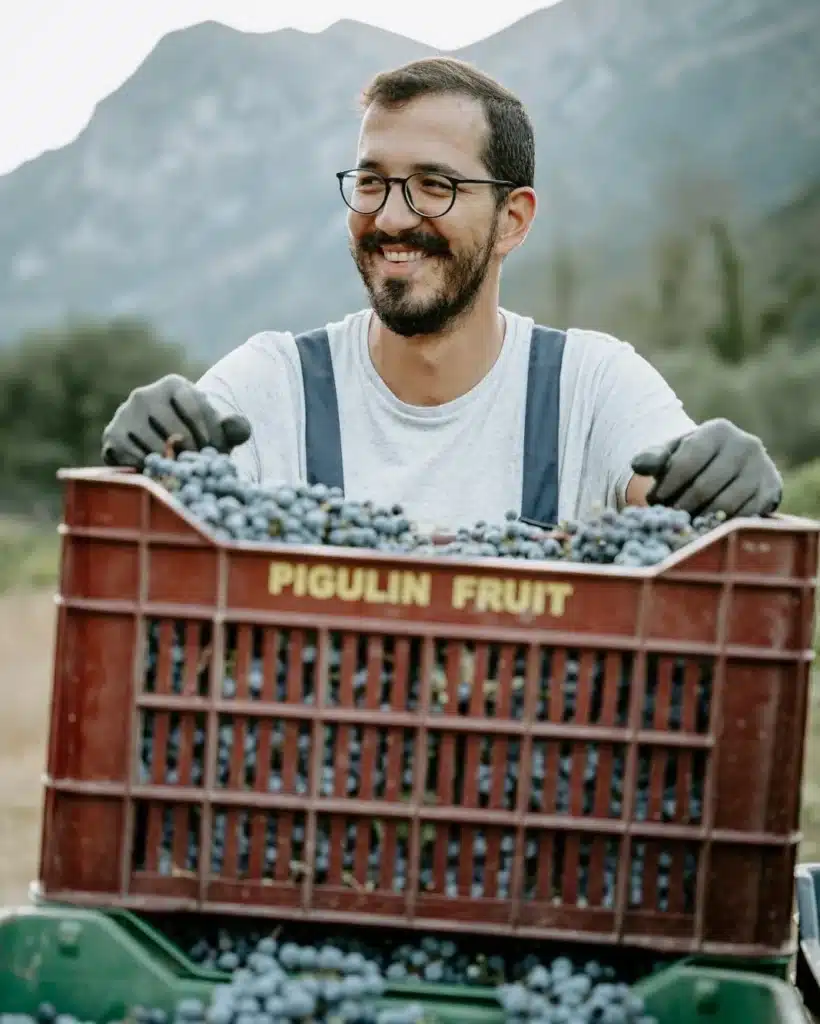
History and family
What was it like growing up in a family that makes wine?
It is certainly special. In our part of the world there are not many families left that make their own wine, even as amateurs. Seeing from a young age my father’s passion and devotion to wine, and the respect he showed for the product itself, filled me with awe. As for the path I chose, to become an oenologist and wine producer, I think what I absorbed growing up played a part, but there was no pressure from my family to follow this profession, or medicine, my parents’ profession. I am grateful to them for that.
Your father, Spyros, started as a dentist. What has his story taught you?
My father, a dentist by profession and very successful in his field, turned his student dream into reality: to make his own wine by replanting his grandfather’s vineyards in Dafni. He did not change course; he worked as a dentist at Filiates hospital in the morning and as a grape grower and winemaker in the afternoon. That he left a strong mark on the local community in both, through his work, his diligence and his honesty, is a legacy that shows me how a young person who wants to chase their dreams should go about it.
What is it like working with your father every day?
For better or worse, we only shared the winery and the vineyard in 2020. That is when I came back, and it was my father’s last active year in wine. There was no tension, but I must admit it took him a little time to realise that he no longer had full control over the daily running of the business. What matters is that even now we talk every day about the needs of the winery, and I consult him often, even when I have already made a decision. Experience, you see, always matters, and it would be a mistake not to seek it.
What have been the biggest difficulties in your career?
The big difficulties are few, but they stay there year after year. First, when you decide to be a farmer, you know you cannot fight nature and its moods. So producing good and sufficient fruit every year takes a strong stomach and endurance. In good vintages the joy is indescribable. In bad vintages you often feel like giving up.
Another chronic problem is the lack of state support for the primary sector. Without exaggeration, there is no real help for small and medium-sized farming businesses, and the constant scandals in our sector prove it. Unfortunately, the state and the institutions are not interested in the growth of the small farmer and entrepreneur or in creating new jobs.
Oenology and philosophy
You studied oenology and came back. What changes did you bring with you?
I studied oenology and viticulture at the Faculty of Agriculture of the University of Florence. I worked at wineries in Tuscany and Bordeaux. I consider myself lucky for everything I saw and learned. When I arrived at the winery, the first thing I changed was the approach to the vineyard. We moved from conventional to organic farming, with excellent results visible from the very first years. Also, since 2021 we have been making low-intervention or natural wines. This means we stopped using any chemicals at any stage of production and ageing.
Why did you choose the natural wine philosophy, and what are the challenges?
The natural wine philosophy is about choosing to make wines with respect for the product, the consumer and the environment. Letting the grapes express themselves and show you what they are made to produce each year. Minimal human intervention, and wines full of aroma, flavour, body and character.
But the challenges are many. The less you intervene as an oenologist, the more you know you are taking risks that could otherwise be avoided. Our winery has no modern technology, and that leads us to traditional winemaking with wild fermentations and native yeasts. The beautiful thing about this process is that every year you see the differences the microclimate creates, and that is very beautiful and desirable. On the other hand, when conditions are not stable, there is a real chance of problems during fermentation.
Which variety or wine expresses you most?
The wine that expresses me most so far is Two Generations red (Merlot–Syrah). First of all, the name and the label itself are dedicated to the winery and its people. Also, red wines are my favourites (I am a child of Tuscany, after all), and these well-known varieties are among my favourite international ones. This wine holds all the anxiety, the struggle and the patience it takes to make a great red wine.
How do you feel when you see your wine in award-winning restaurants such as Thamon?
Being on the lists of award-winning restaurants is very nice and certainly a reward for your work. But it does not allow complacency. It takes hard work every day for the winery’s name to grow and for more partnerships to follow with places that know how to serve a sensitive product like wine and that respect the winemaker.
20 years: looking back
20 years of Markatselis Winery. What have you achieved?
It feels unreal. I believe we have done our part to make Thesprotia known as a wine region. Our activities are many and varied; they are all about educating the wine public, and we try to achieve that through culture. It is no coincidence that the wine-and-culture summer we created for three years was a complete success, or that the tastings we organise at the winery and at the wine bar are so successful.
What is your vision for the future?
We want Markatselis Winery to grow in space and technology, with the new winery that is coming soon, and in vineyards. Our vision is to keep making honest, tasty wines and to open more paths in Greece and abroad. We want to reach the point where Thesprotia becomes a place visitors come to for its wine too. Not only for its beaches.
What role do you think you played in the growth of wine tourism in Thesprotia?
Our winery was the first in Thesprotia to open its doors widely to the public, in 2022, and to invite people to come and see what we mean by wine tourism. The fact that more than 4,000 wine lovers have visited us is impressive, and I think we are showing how a small business in a border prefecture can work through gentle tourism.
The wine bar
What made you open the wine bar in Igoumenitsa?
The new wine bar is a dream from my student years, influenced by Italy and France. I wanted to bring the culture of the Italian enoteca and the French bistro to Igoumenitsa, where wine is the star, accompanied by cold dishes made from excellent local products. But the aim was also to show our work widely to the people of Thesprotia and Epirus, to make it easier for them to taste our wines and simpler to sell bottles from our own shop.
What experience do you want it to offer?
We want visitors to feel good in a comfortable, warm space where they can enjoy wine and boards of cheese and cured meats, talk with friends, listen to music and relax. I believe our space is a cultural hub for wine, where tastings, concerts, book presentations and painting and photography exhibitions already take place. We have created a lending library, and our goal is for people in the town to fall in love with books again.
Who is the guest you “see” at the wine bar?
Our space is open to anyone with open antennae who wants to taste and learn about wine. We certainly aim at locals from Thesprotia and Epirus, but the first tourists are already starting to appear.
Local roots and message
How do people react when they hear “wine from Thesprotia”?
At first people were very surprised to learn that Thesprotia produces wine. This was especially strong at the trade fairs we took part in. Now I think consumers know more about Thesprotian wine every year, and the other wineries of the prefecture help with that too, with very worthwhile efforts both in their wines and in wine tourism.
What would you say to a young person who wants to follow a similar path?
The romantic Alexandros would tell a young person to try to go back to their home place and make use of whatever heritage there is, or to start something from scratch in the countryside of this beautiful country. The realist Alexandros would discourage any young person from going back. Unfortunately, conditions cannot be favourable for young people and for farmers.
If you had to describe Markatselis Winery in a single sentence?
“Markatselis Winery: a family business that, with respect for people and the environment, works with endless romanticism for a better wine present and future.”
Thesprotia as an emerging wine destination
At the foot of Mount Farmakovouni, among vineyards, herbs and Natura 2000 trails, Markatselis Winery is writing a story that goes beyond a single wine producer. It is a story about a whole place, Thesprotia, and it shows that gentle, quality tourism can be born anywhere, even in a border prefecture. When you visit the Igoumenitsa area, for the beaches of Sivota or the picturesque mountain villages, it is worth making time for this winery. You will leave with a bottle, but above all with the feeling that you have met a family that deeply believes in what it does.
Information
- Winery: Dafni, Filiates, Thesprotia
- Wine shop: Igoumenitsa
- Website: markatseliswinery.gr
- Instagram (winery): @markatseliswinery
- Instagram (wine shop): @markatselis.wine.shop
- Facebook: Markatselis Winery
- Wine tours: April to late October, by appointment.