

About 25–30 minutes. That’s typically how long it takes to drive from the port of Igoumenitsa before the world around you changes completely. The sea disappears behind you, the road toward Filiates climbs into dense forest, and then, perched dramatically on the slopes of Mount Farmakovouni above the Kalamas valley, Foiniki appears: an entire village built from stone, houses that look like small fortresses, cobbled lanes climbing step by step, and arched stone gateways — the oldest dated to 1840.
It’s not by chance that Greece’s Ministry of Culture designated Foiniki a protected settlement of “outstanding natural beauty” in 1976. It’s widely considered the best-preserved traditional village in Thesprotia — and unlike many “museum villages,” life here hasn’t stopped: a folk museum has recently reopened, an annual arts festival fills the square, two wineries sit a few minutes outside the village, and a music taverna on the square is reason enough on its own to make the drive.

A Village Built for Refuge — From 1450 to Today
According to oral tradition, the original settlement stood lower down, on the plain. After 1450, when the Ottomans took control of the region, the Christian population retreated into the mountains for safety — and gradually built their new village high on an inhospitable but defensible slope. That same need for protection from raids, through the 15th and 16th centuries, shaped the village’s distinctive architecture: fortress-like houses built wall to wall, with paved courtyards, tall stone perimeter walls, and only one way in — through an arched courtyard gate.
Until 1900, the village appeared in records as “Foiniki” (Φοινίκη), and the origin of the name is still an open question. One theory traces the first inhabitants to the Delvina area of present-day Albania, near the ruins of ancient Phoenice of the Chaonians. Another connects the name to foinikia, the traditional bridal jewelry of the region — which today has become the symbol of the Folk Museum.
The place itself was poor. From the 18th century, young men emigrated to Bulgaria, Wallachia, and Constantinople; from 1900 onward, many went as far as America. The money sent home built the handsome two-story mansions still standing today — and by 1900, Foiniki had three schools: a primary school, a scholarcheio (upper school), and a parthenagogeio (girls’ school). For a mountain village in Thesprotia at that time, this was remarkable, and it explains why so many scholars and scientists trace their roots back here.
What You’ll See: Architecture Found Nowhere Else
Foiniki is a village you walk, not one you see from a car. Leave your vehicle at the village entrance and take the cobbled lanes at your own pace.

The arched courtyard gates are the village’s signature feature. The oldest dates to 1840, but the tradition continues today — you’ll see both centuries-old and recently built gates, painted in different colors, with carved lintels and metal door-knockers. They’re among the most photogenic architectural details in all of Epirus.
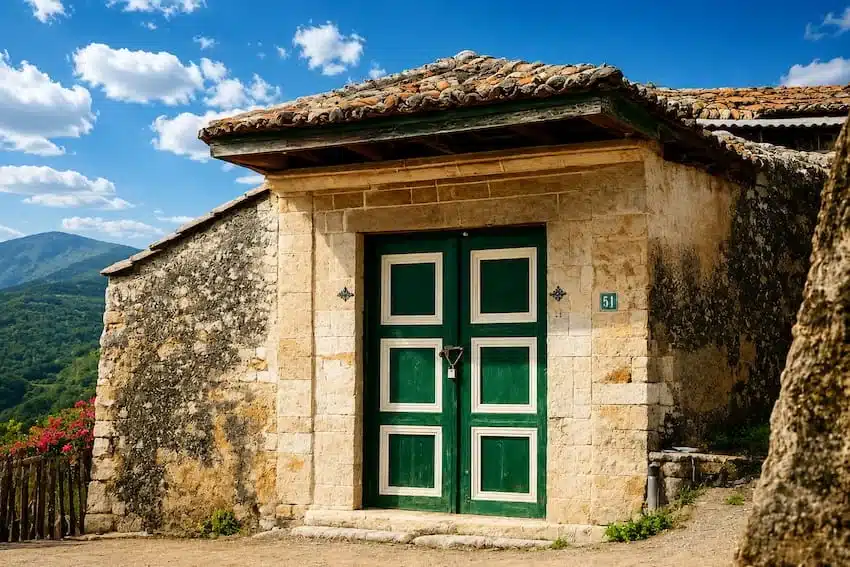

The 18th-century stone mansions, two and three stories high and built with money sent home from abroad, are in remarkably good condition — without the “modern alterations” that have changed the character of other villages, as the 1976 protection order itself noted.
The Church of the Transfiguration of the Savior with its courtyard, the old olive press by the cemetery, and the view over the Kalamas valley round out the walk.

Foiniki Folk Museum
At the center of the village, in a two-story Ottoman-era building that once housed tax collectors and later served as a guesthouse and community office, you’ll find the Foiniki Folk Museum. The idea belonged to Professor Fotis Mitsis and was carried out by a group of villagers led by dentist Michalis Manos: the founding association was established in 1993, residents opened up old chests and storerooms to donate household objects, and the museum opened its doors in 1996.
Following a recent renovation, the museum is open again and has grown into something of a cultural hub for the whole of Thesprotia — everyday objects, tools, woven textiles and traditional dress, plus exhibitions and the Foiniki Arts Festival, which brings sculpture, music, dance, and theatre to the village.
- Hours: Sundays, 11:00–14:00
- Entry: €2, children free
- Groups & schools: by arrangement — call +30 697 215 7852 (Dimitra Karabina)
- Website: mouseiofoiniki.gr
- Instagram: @foiniki_folk_museum
Tip: if you’re visiting on a Sunday, the ideal combination is the museum at midday, a walk through the cobbled lanes in the afternoon, and dinner at Lodza in the evening.
- Hiking in Foiniki — With a Certified Mountain Guide
The countryside around Foiniki — forest, trails, views over the Kalamas valley with the Mourgana mountains as a backdrop — is made for walking. And here you’ll find something few villages in the region offer: an organized hiking experience with a certified mountain guide, Theodoros Manos, a local of the village and owner of Lodza.
The educational hike is designed for schools and student groups of all ages but can be adapted for any group. Along the route, participants learn to identify local plant life, pick up basic geology and orientation skills, get familiar with mountain safety rules, and hear local stories that tie the natural landscape to the village’s cultural heritage.
It’s run properly: the trail is checked before every outing, participants receive a safety briefing, a first-aid kit is on hand, and safety protocols are followed. Duration ranges from 30 to 90 minutes depending on the age and ability of the group, and the route ends on the village square at Lodza, with a meal, games, and free time to explore.
Information & bookings: Theodoros Manos, Mountain Guide 📞 +30 694 715 7523 📧 theodmanos08@gmail.com
Where to Eat: Lodza
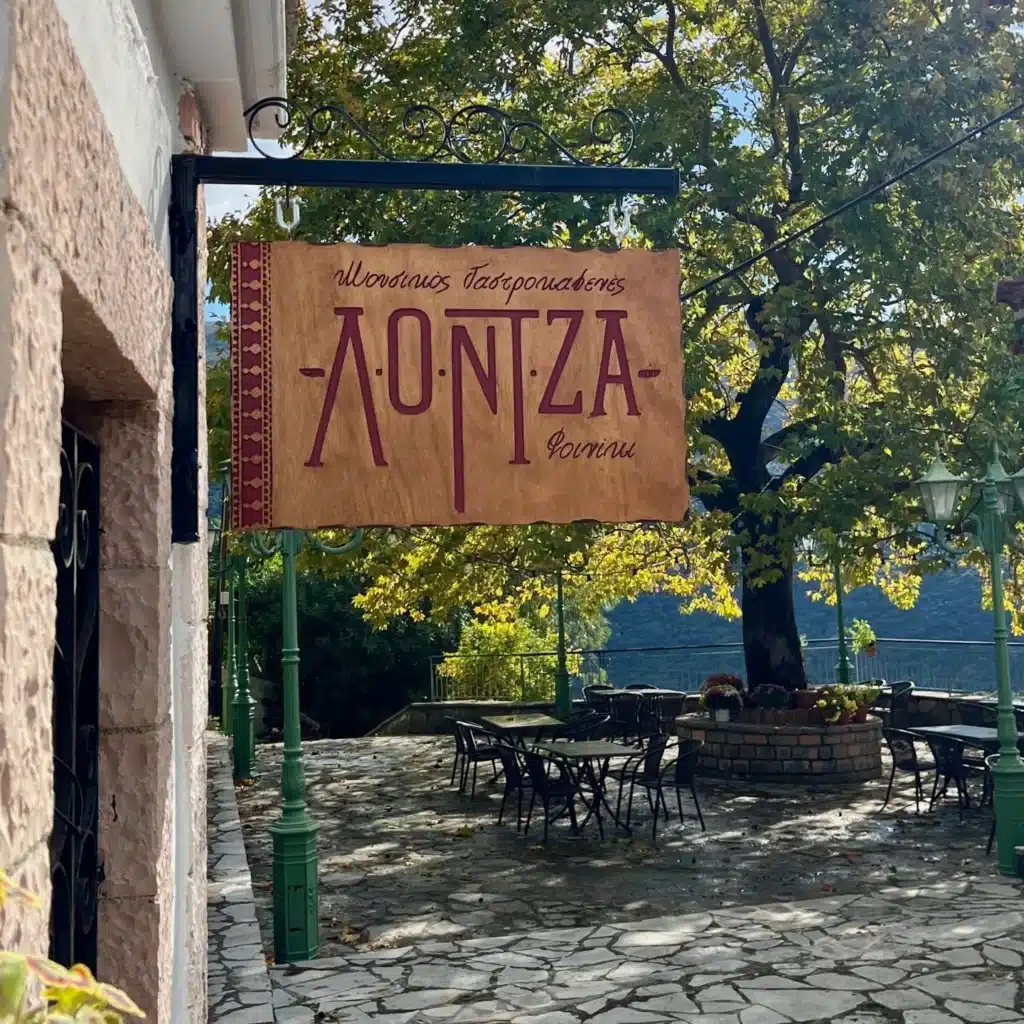

On the village’s central square, Lodza — Theodoros Manos’s music taverna — serves grilled meats, seasonal dishes, and live music, all in the atmosphere of the old lodza, the village’s traditional communal sitting area.
Open Friday, Saturday, and Sunday evenings (20:00–01:00). Call ahead before making the drive: +30 694 715 7523.
Wine Tourism Nearby
A few minutes from the village lie the vineyards of two local wineries — Markatselis Winery and Zervas Winery. A meal at Lodza combined with a tasting visit to one of the two makes for the most complete half-day of wine tourism that Thesprotia has to offer.
Wine tourism in the area is still small-scale — and that’s exactly its charm. Don’t expect packaged tours; expect the producers themselves showing you around their barrels. Call a day ahead, as visits are by arrangement.
How to Get There
Foiniki is about 25–30 minutes by car from Igoumenitsa. From the port, take the Ioannina–Igoumenitsa national road toward Filiates, turn off at the junction for Filiati, and just before entering the town, turn again toward Foiniki, 5 km to the northeast. The road is paved the entire way, with switchbacks on the final climb as you approach the foot of Mount Farmakovouni.
🚗 You will need a car. There is no regular bus (KTEL) service to Foiniki — the only way in is by your own vehicle or by taxi from Igoumenitsa or Filiates. Inside the village, cars stay at the entrance; the cobbled lanes climb uphill and can only be explored on foot.
Don’t have a car? The most convenient option is to rent one at Igoumenitsa port, where local companies typically offer pickup right at your arrival point. See our full guide: Car Rental in Igoumenitsa
Good to Know (The Honest Bit)
Foiniki has just 20 permanent residents. There are no shops, no gas station, and no tourist infrastructure — that’s a large part of its charm, but come prepared. Lodza only opens on weekend evenings and hours can shift seasonally, so calling ahead isn’t optional. The museum opens Sunday mornings only (or by arrangement for groups). The cobbled lanes are steep and can be slippery when wet — wear closed, sturdy shoes. And there’s no practical public transport for an afternoon or evening visit — it’s your own car or a taxi.
Loading this content connects to Google Maps, which may set cookies and see your IP address. See our Cookie Policy.
Open in Google Maps (opens in a new tab)Καλό να ξέρεις (η ειλικρινής ενότητα)
Το Φοινίκι έχει 20 μόνιμους κατοίκους. Δεν υπάρχουν μαγαζιά, βενζινάδικο ή τουριστικές υποδομές — αυτή είναι και η γοητεία του, αλλά έλα προετοιμασμένος. Η Λόντζα ανοίγει μόνο σαββατοκύριακα το βράδυ και οι ώρες μπορεί να αλλάξουν εποχιακά· το τηλεφώνημα πριν ξεκινήσεις είναι υποχρεωτικό. Το μουσείο ανοίγει μόνο Κυριακή πρωί (ή κατόπιν συνεννόησης για γκρουπ). Τα καλντερίμια είναι ανηφορικά και ολισθηρά με βροχή — φόρεσε κλειστά, σταθερά παπούτσια. Και δεν υπάρχει πρακτική συγκοινωνία για απογευματινή/βραδινή επίσκεψη — μόνο δικό σου όχημα ή ταξί.
Sources & References
This article was compiled by the IgoumenitsaSTAY team, drawing on:
- Thespro.gr — local news coverage and recognition of the settlement
- Foiniki Folk Museum — historical documentation and heritage preservation
