
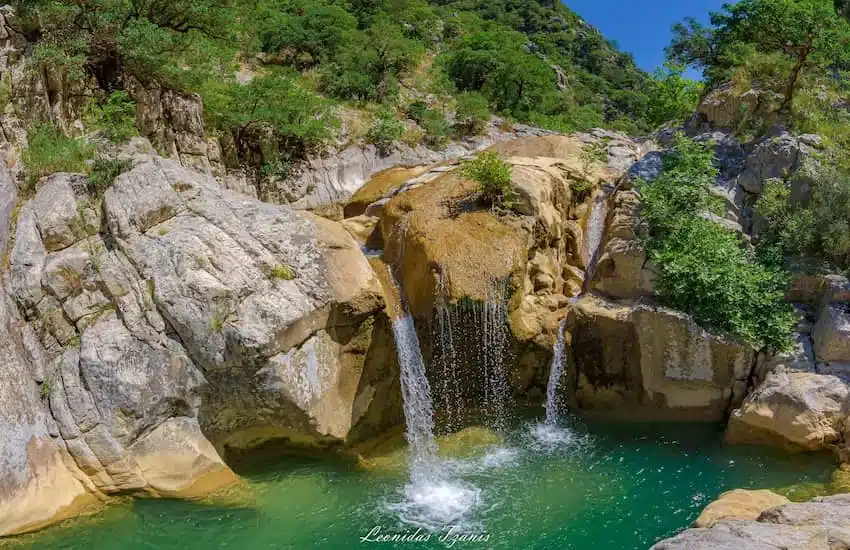
A few kilometers from the border with Albania, on the slopes of Mount Laggari, a mountain stream has carved a series of deep-blue natural pools over time. Known to the locals as “Vothnes” (or “vires”), these pools are located in the Laggari Gorge, between the mountain village of Keramitsa and the settlements of Dafni (Tzouma), Rizo, and Kokkinolithari in the Municipality of Filiates. They remain one of Thesprotia’s best-kept secrets—a stunning natural landscape perfect for visitors seeking an alternative to the popular Ionian beaches.
This guide explains what the Vothnes are, how to reach them, what to expect, and—equally important—the restrictions and risks you must know before you go.

What are the Vothnes?
The term “vothnos” (or “vathra”) is used in the Greek countryside to describe natural pools formed at the base of waterfalls or within bedrock depressions. Over years of swirling, the water “drills” into the rock, creating these natural swimming pools. In the case of Keramitsa, the Potamia stream crosses a narrow, rocky passage beneath the historic “Laggari” cobblestone path, forming consecutive pools—some small and shallow, others deep enough for a dive.
In some sections, the vertical walls of the canyon draw so close together that they create the feeling of a natural stone bridge—a sight that, according to local legend, reminded the older generations of a gate to the underworld.


Where are they located?
The Vothnes are situated within the administrative boundaries of Keramitsa, a mountain village in the Municipality of Filiates, built at an altitude of approximately 580 meters on the slopes of the mountain of the same name. It lies about 20 km northeast of Filiates, near the Greek-Albanian border.

Approximate driving distance:
- From Igoumenitsa to Filiates: ~18 km (approx. 25 minutes)
- From Filiates to Keramitsa: ~19–20 km of mountain road.
- Total: Plan for about 45–60 minutes of driving from Igoumenitsa to reach Keramitsa. (Note: The road after Kokkinolithari is not in the best condition, so allow extra time).

How to reach the gorge entrance
There are two access points, one at each end of the gorge:
- From the West (Dafni / Rizo / Kokkinolithari) — The easier, standard route: Follow the provincial road from Filiates toward Keramitsa. Near the settlement of Dafni (also known as “Tzouma”), heading toward Kokkinolithari, you will find the old stone path—the Laggari Cobblestone Path (Skala Keramitsas)—on your right. From there, begin the descent toward the stream, following the sound of the water until you reach the old “Balaouras” watermill and, slightly further down, the first and largest pools.
- From the East (Keramitsa village): Descending from the village, the route starts at the Gior Tolis Bridge, which historically connected the path from Achouria Malouniou to the Laggari path. This side is considered more demanding.
Expert Tip: If you reach the village square of Keramitsa, ask the locals. According to travel blogs, the residents are usually happy to guide visitors to the attractions—invaluable in an area where paths are not always clearly marked.
Loading this content connects to Google Maps, which may set cookies and see your IP address. See our Cookie Policy.
Open in Google Maps (opens in a new tab)Difficulty & Safety
This is not a stroll for families in flip-flops. Visiting the Vothnes is a form of natural canyoning and mountain hiking that requires:
- Good physical condition and balance for uneven, rocky, and slippery terrain.
- Sturdy, closed-toe footwear with good grip (no sandals).
- Rope assistance: In some passages, you may need a rope. If you lack canyoning experience, stick to the path via the Laggari Cobblestone trail, which is gentler.
- Company: Never enter an isolated canyon alone.
- Awareness: Water levels vary significantly. After heavy rain, the stream can be dangerous.
When to visit
- Spring (April–June): The stream has the richest flow and the landscape is at its greenest—ideal for photography, though less ideal for swimming due to stronger currents.
- Summer (July–August): Lower water levels make access safer and allow for a refreshing dip after your hike.
- Autumn/Winter: Avoid after heavy rainfall, as the canyon can flood.
Historical Context: The Laggari Cobblestone Path
The stone path above the gorge is a piece of history. Built around 1710, the Laggari Cobblestone Path (Skala Keramitsas) was part of an old trade route connecting Ioannina to the port of Sagiada. It remains well-preserved after three centuries of use. Near Keramitsa, in the Agios Athanasios area, one can also find ruins of a Hellenistic or Roman fortified settlement, proving this gorge has been a transit point for millennia.
Quick Facts
- 📍 Location: Laggari Straits, Municipality of Filiates, Thesprotia.
- 🚗 Drive from Igoumenitsa: ~45–60 mins.
- 🥾 Type: Mountain hiking / natural canyoning.
- 📏 Route length: ~6 km.
- ⛰️ Elevation gain: ~500 m.
- 🎫 Cost: Free, public access.
- ☀️ Best time: Spring (views/flow) or Summer (swimming).
- ⚠️ Difficulty: Moderate to difficult — requires experience on rough terrain.
Where to Stay
According to local reports, Keramitsa has a small traditional guesthouse. However, as rooms are very limited, it is strongly recommended that you confirm availability in advance through the village or local authorities rather than relying on same-day bookings.
Most visitors prefer to stay in Igoumenitsa or Sivota and visit the Vothnes of Keramitsa as a day trip. Staying in the coastal areas offers more reliable accommodation options, while still being within a reasonable driving distance of the mountain trails.
Disadvantages & What to Watch Out For (An Honest Review)
No experience is perfect for everyone—here is what you need to know before you decide:
- Difficult Access: The road after Kokkinolithari is not in the best condition; drive with caution, especially if you have a low-clearance vehicle.
- Lack of Infrastructure: There are no organized trails, signs, restrooms, parking, or dining facilities at the entrance of the gorge.
- Poor Connectivity: Mobile phone signal is weak or non-existent within the narrow passages—always inform someone of your plans before heading down.
- Technical Sections: Some parts of the route require rope assistance or basic scrambling/climbing; this is not suitable for young children or those without experience on rugged, uneven terrain.
- No Guided Tours: We could not locate any official organized canyoning tours for this specific route; it is primarily an experience for self-reliant explorers or those coordinating through local mountaineering clubs.
- Water Level Volatility: The experience changes significantly depending on the season; some pools may be dry during the summer following prolonged periods of drought.
Frequently Asked Questions (FAQ)
Are the Vothnes of Keramitsa suitable for families with children?
The milder part of the Laggari Cobblestone Path can be walked by most family members. However, the descent into the gorge toward the actual pools involves rocky passages and, in some places, requires rope assistance. It is not recommended for young children or individuals without experience on rugged terrain.
Is special equipment required?
For simple hiking along the historic path, sturdy hiking shoes are sufficient. If you plan to descend to the pools and navigate the narrows, wear shoes with good traction that can get wet, and ensure you have a rope or are accompanied by someone with experience.
How long does the visit take in total?
The historic path alone takes about 2 hours to walk. If you include the descent into the gorge and time spent at the pools, allow for a total of 3–5 hours, depending on how much you plan to explore.
Can I swim in the pools?
Yes, some pools are deep enough for a swim, especially in the summer when water levels are lower and the currents are calmer. Always check the depth and currents before diving or entering the water.
What is the best time for photography? Spring is ideal, when the vegetation is lush and the water flow is at its peak, offering the most impressive shots. Keep in mind that the lighting inside the narrow gorge is best during midday hours, when the sun reaches the bottom of the stream more directly.
Acknowledgments
A big thank you to Mr. Leonidas Tzanis (you can view his work here) for graciously providing the photographic material and for his expert knowledge, which was instrumental in the creation of this article.