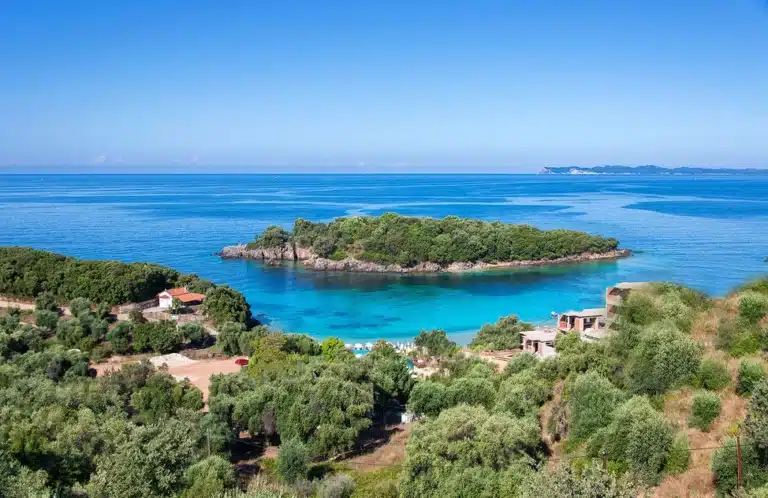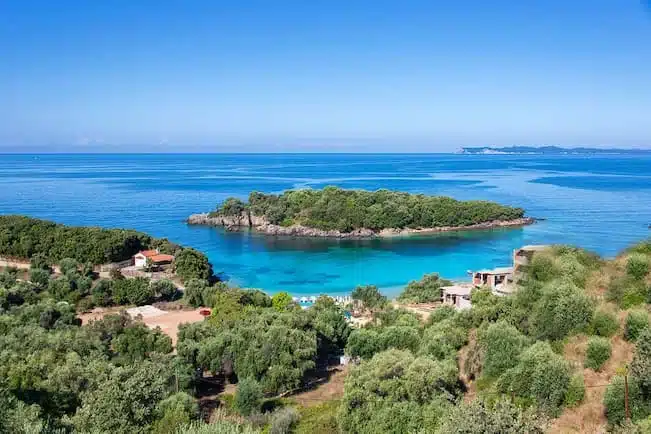
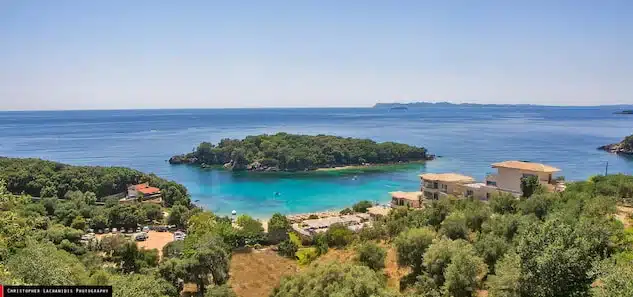
A tiny green island just offshore, water so calm it looks like a pool, and a white chapel on the rocks — Agia Paraskevi, between Sivota and Perdika, is one of the most beautiful beaches in Thesprotia. Here’s everything you need to know.
For many locals, Agia Paraskevi is simply the most beautiful beach in Thesprotia — and the moment you catch sight of it from the road above, you understand why. A tiny green islet sits just offshore in a bay of impossibly clear turquoise water, with a little white chapel perched on the rocks at one end and olive groves climbing the hills behind. It’s the kind of view that stops people mid-drive. Best of all, the island is close enough to swim to, and it shelters the bay so completely that the sea stays calm and glassy even on windy days.
- Agia Paraskevi at a glance
- The beach and its island
- Facilities: sunbeds, food and water sports
- How to get to Agia Paraskevi
- Best time to visit
- Frequently asked questions
- Are there other great beaches nearby?
- Where to stay nearby
Agia Paraskevi at a glance
The beach and its island
The islet is what makes Agia Paraskevi special. It sits only about 100 metres from the shore — close enough that confident swimmers reach it easily, and there’s a tiny beach on the far side where you can feel like you have your own private cove. Many visitors paddle across on a SUP or a pedal boat instead, and the rocky seabed around the island is one of the better spots in the area for a snorkel.
Because the island stands guard across the mouth of the bay, the water inside stays remarkably calm — flat and clear even when the wind is up elsewhere on the coast. Combined with a long, gently shelving shallow section, that makes Agia Paraskevi a firm favourite with families and anyone who likes to wade out a long way before it gets deep. The sand is a mix: finer and softer at the end nearest the chapel (the best stretch for small children), coarser with some small pebbles toward the other end.
The chapel of Agia Paraskevi
At one end of the beach, built right onto the rocks beside the sea, stands the small white chapel that gives the beach its name. It looks straight out across the water to the islet, and the short walk up to it rewards you with one of the best views of the whole bay. The chapel celebrates its feast day on 26 July, but it draws people all summer for another reason: it’s a hugely popular spot for weddings and christenings, with couples travelling from all over to be married in such a postcard setting. If you’re after the photo, late afternoon light here is gorgeous — and the nearby viewpoint (locally called Paratiritirio) is a classic place to watch the sun drop behind Corfu.
Facilities: sunbeds, food and water sports
Agia Paraskevi is a fully organized beach, but it never feels overrun. You’ll find sunbeds and parasols for hire — some belong to the beach hotels and are rented to non-guests, with prices varying from bar to bar (roughly €5–15 a set, with a few premium cabins costing more) — plus plenty of free space to lay your own towel if you’d rather. A beach kiosk sells drinks, snacks and ice cream, there are tavernas on the sand and several more along the main road just behind, and a water-sports outfit operates from the far end of the bay (SUPs, pedal and hydro boats, canoes) without taking over the beach. There’s parking at the entrance, a ramp for wheelchair access, and a lifeguard usually on duty in the high season.
How to get to Agia Paraskevi
Agia Paraskevi sits on the coastal road between Sivota and Perdika, about 6 km (a 10-minute drive) south of Sivota and roughly 9 km from Perdika village. From Igoumenitsa, allow about 30–35 minutes by car — head south toward Sivota, then continue on the Sivota–Perdika road; the beach is signposted, with a parking area at the start of it. A car is really the only practical way to get here, as public transport on this stretch is minimal in summer (see our car rental guide or, if you’d rather not drive, taxi services).
Parking tip: The car park fills quickly on summer weekends and from mid-July to mid-August. Arrive before mid-morning to be sure of a space — and if you want the beach at its quietest, come early or late in the day, or visit in June or September.
Best time to visit
Like the rest of the Thesprotia coast, Agia Paraskevi is at its best in late spring and early autumn — May, June and September bring warm, calm water, easy parking and far fewer people. July and August are beautiful but busy, so an early start makes all the difference. The sheltered bay stays swimmable well into October.
Nearby beaches and things to do
Agia Paraskevi makes an easy combination with the other beaches on this stretch. Just 1 km toward Sivota is the triple cove of Mega Drafi, great for snorkelling; further along lie the long sands of Karavostasi and the shallow, family-friendly Arillas near Perdika. Inland, the village of Perdika is worth a wander for its tavernas and its 1811 stone chapel of Saint Athanasius, while the ancient fortified site of Dimokastro and the wooded National Park along the Paramythia river are both close by for a change from the beach.
Where to stay nearby
Agia Paraskevi is an easy day trip from Igoumenitsa, but if you want to be close to the southern beaches, stay in or around Sivota. See our guides to where to stay in Sivota and where to stay in Igoumenitsa, and browse the full Beaches near Igoumenitsa guide for the rest of the coast.
Photography credits: Many thanks to George Lachanidis and perdika.info for the beautiful images of Agia Paraskevi.